

In this issue, I examine Sisi’s latest speeches and the uncertainty surrounding his succession after 2030. I also cover the fallout from the killing of Sudanese gold miners, EU funding for migration controls, Future of Egypt’s expanding economic empire, and the mounting death toll from police “shootouts.”
Sisi Blames Everyone Else
Sisi warned against street unrest and held the citizens responsible for the country’s future in speeches on 14 and 15 October.
At the army’s “educational seminar” marking the anniversary of the October 1973 War, he repeated similar calls on the public to assume responsibility, work harder and wake up earlier. “I said we’d start at 5 am,” he recalled, before complaining: “I woke up, and then nobody woke up.” He has been the solitary early riser waiting for an idle nation to catch up, while citizens fail to match his work ethic.
Sisi also insisted nobody would touch the constitution, responding to speculation about who would govern beyond 2030.
The trauma of 2011, as always, dominated his speech. He blamed the protests for exhausting foreign reserves and damaging the economy. He also compared the 1973 War to “regain the land” to his coup in 2013 to “regain the [Egyptian] state and identity.” After praising the late president Anwar Sadat, Sisi likened the “conspiracy” of the 1977 protests to similar “plots” to bring down the Egyptian state in 2011.
Sisi, moreover, claimed he had urged then-head of SCAF Field Marshal Mohamed Hussein Tantawi to accept Muslim Brotherhood rule if the group won elections, but had predicted its failure.
The Ministry of Defense (MOD), for its part, published a propaganda clip, blaming 2011 for US$450 billion losses and instability. But thankfully, Sisi is here, and he saved the day.
The following day, 15 October, Sisi attended the Police Academy graduation ceremony, where he once again was keen to remind the public of “conspiracies,” “what happened in 2011,” and internal plots to destroy all the wonderful things Egypt has achieved since 2013.
“Egyptian national security rests on two institutions: the police, or the Interior Ministry, and the armed forces, or the Defense Ministry,” he said. “Any attempt targeting these two wings is targeting the stability of this state.”
The enemies, he warned, are standing by and telling themselves, “After everything that’s been done since 2011 until now, Egypt is still standing, still building and developing, and solving its problems. No, we won’t leave you alone.”
He finally urged the public to “Please speak, tell people, recount what happened, because of the memory they are trying to distort and erase, replacing it with words that, by God, are lies. By God, falsehoods. By God, fabrications.”
Who Is Sisi Talking To?
Who was Sisi addressing when, on 29 September, he warned against attempts to set state institutions against one another? Speaking before military, police and civilian officials, he specifically mentioned the Ministry of Interior (MOI), judiciary and army, calling for institutional cohesion and urging officials to express their views openly.
On 14 October, he insisted nobody would touch the constitution, apparently ruling out another extension of his presidency beyond 2030. Was he reassuring the public, or addressing growing unease within the ruling establishment?
The confusion was visible almost immediately. Several news websites deleted reports that quoted Sisi’s remarks regarding the constitution. This was roughly around 5 pm. They republished them only after the presidential spokesperson released his speech at 7 pm, roughly two hours before its television broadcast.
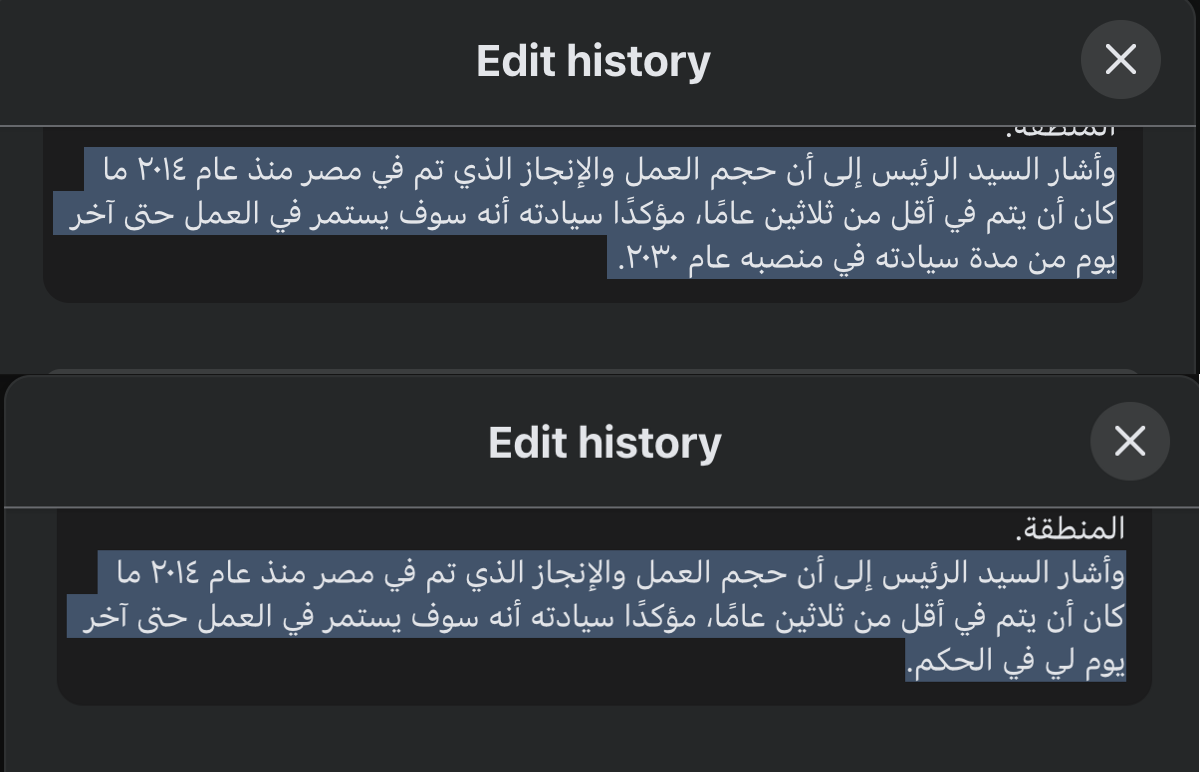
Further confusion emerged when the presidential spokesperson, within minutes of publishing a statement on 15 October, quietly deleted a reference to Sisi remaining in office until 2030, replacing it with the open-ended assurance that he would continue working until his last day in power. The original wording remains visible in the post’s edit history on Facebook.
Meanwhile, the MOI’s Homeland Security-backed Nation’s Future Party and the Military Intelligence-backed Homeland Defenders Party remained silent. They issued no statements on the constitutional remarks. Such hesitation hardly suggests a ruling establishment confidently following a settled succession strategy.
Mada Masr quoted an anonymous parliamentary source claiming Sisi had privately declared: “I won’t wait for the defense minister to tell me to go to Sharm el-Sheikh,” invoking Hosni Mubarak’s downfall in 2011. Meanwhile, regime loyalist Mortada Mansour interpreted Sisi’s constitutional remarks as a definitive commitment to leave office, while other supporters demanded he remain.
An apparently bogus campaign promoting Sisi’s son Mahmoud, which pro-regime presenter Ahmed Moussa blamed on the Muslim Brotherhood without substantiating the allegation, further muddied the waters.

The confusion continued on 17 October, when Sisi delivered an extraordinary speech at the Military Academy graduation ceremony. He revealed that pro-regime broadcasters Nashat al-Deehi and Mostafa Bakry had questioned him about what would happen after his current term. This time, he was explicit: “In 2030, my term as president will end, if I live that long. This is completely settled and will not be discussed.” He also disclosed that Bakry had urged him against discussing the succession question publicly.
Sisi then outlined a proposed mechanism for preparing future leaders, including potential presidential candidates, under the supervision of the Egyptian Military Academy. With approximately 43 months remaining before 2030, he suggested selecting hundreds of candidates, principally holders of advanced university degrees, aged between 40 and 50, for a 30-month training program. The Speaker of Parliament, politicians, and the ministers of higher education and justice would put together the selection mechanism. The armed forces would finance the training. Egyptians could subsequently elect their leaders from this pool of military-trained candidates, although Sisi said participation would not formally exclude others. The initiative would also produce future ministers, governors, and senior officials.

The Military Academy has become an instrument for militarizing the civilian bureaucracy, screening recruits and subjecting teachers, diplomats, civil servants, and other professionals to military training and ideological indoctrination. Sisi is now proposing to extend this model to the political leadership itself. He explicitly denied preparing a family member or relative to succeed him, rejecting suggestions of hereditary succession. He insisted that Egypt could produce leaders considerably better than himself, provided they underwent “appropriate preparation.”
More revealingly, Sisi invoked Article 200 of the constitution, assigning the armed forces responsibility for safeguarding the constitution, democracy, and the state’s fundamental institutions. He claimed he had insisted on including this provision when the constitution was drafted in 2014, although the relevant language was actually introduced through the 2019 amendments. Basically, this means a military institution empowered to determine who is qualified to govern. “Not just anyone who can string two sentences together” should be allowed to lead the state, he warned.
Such an arrangement is Turkey’s pre-Erdoğan political order—where the military appointed itself guardian of the constitutional system and repeatedly intervened whenever civilian politics were deemed to have crossed certain red lines. Sisi appears to be contemplating a similar guardianship arrangement, with the Military Academy preparing an approved political elite and the armed forces retaining a decisive role in safeguarding the system.

Finally, Sisi made a striking overture to his Gulf sponsors. Recalling the financial and material assistance provided by Saudi Arabia, the UAE, and Kuwait following the 2013 coup, he ordered troops participating in the ceremony to perform a military salute honoring those countries. He then declared that Egypt was prepared to take whatever measures were necessary to defend Saudi Arabia. He called for an emergency parliamentary session to authorize military action if such assistance were requested, stressing that any intervention would be defensive. No deployment was announced. Nevertheless, the demonstration of loyalty to the Gulf monarchies is worth noting amid the ongoing uncertainty over Sisi’s future.
The timing was also telling. Just a day before Sisi’s extravagant declarations of Gulf solidarity, Asharq Bloomberg reported that Cairo was negotiating with Riyadh to renew $5.3 billion in Saudi deposits at the Central Bank, falling due in October.
Sisi’s promises obviously lack credibility. In 2017, he declared his opposition to amending the constitutional limit of two four-year presidential terms; only to engineer amendments in 2019 to ensure he continues ruling until 2030. There is little reason to assume his latest pledge will prove any more binding.
In my book, Counterrevolution in Egypt, I argued that Sisi had unified the repressive apparatus for the first time since 1952. Yet this unprecedented unity was never guaranteed to last. The 2025 parliamentary elections already exposed tensions among security agencies, while the deepening economic crisis places the entire ruling coalition under increasing strain.
I find it hard to believe Sisi willingly intends to relinquish power. What seems less certain is how he can engineer another extension without destabilizing the very coalition sustaining his rule. It is still unclear which forces, if any, within the state apparatus oppose his continuation. His frantic appeals for unity, though, and the conflicting signals from regime loyalists, suggest a rift or at least confusion about what lies ahead.
The present level of socio-political dissent remains insufficient to trigger a serious rupture at the top, despite the slow, incremental rise in industrial actions. Yet the security agencies monitoring public sentiment must surely recognize how deeply hated Sisi has become for a long list of reasons, most importantly the economic deterioration. A spontaneous explosion of popular anger is not inconceivable.
Finally, what do Saudi Arabia and the UAE—the regime’s most important sponsors—think? Are they OK with Sisi remaining in office beyond 2030? The answer is still unclear, but Sisi can no longer take for granted the support Saudi Arabia and the UAE gave him during the 2013 coup and its aftermath.
Throughout history, quarrels among the gods atop Mount Olympus have created openings for the commoners below to begin moving, organizing, and challenging their rulers. The emergence of cracks within the ruling establishment could once again provide such an opening. It is a scenario worth watching closely.
