
The Fall of Nakhnoukh
Egypt Security Sector Report

This week’s issue covers Sabry Nakhnoukh’s fall and the latest case against him, Egypt’s quiet participation in Gaza’s stabilization force, signs of a fragile rebound in Suez Canal traffic, OECD criticism of the military’s role in the food sector, reported plans to restructure the Future of Egypt agency, efforts to legalize GMO seeds, AFTE’s findings on social media policing, and concerns over debt service in the 2026/2027 budget.
Counterrevolution in Egypt
I was interviewed by Socialist Worker about my book.
The Thug King Falls Out of Favor
Sabry Nakhnoukh’s fall is not the story of a gangster finally exposed by a vigilant state. It is the story of a gangster produced, tolerated, recycled, and promoted by the state, only to be discarded when his usefulness, protection, or political value appears to have expired.
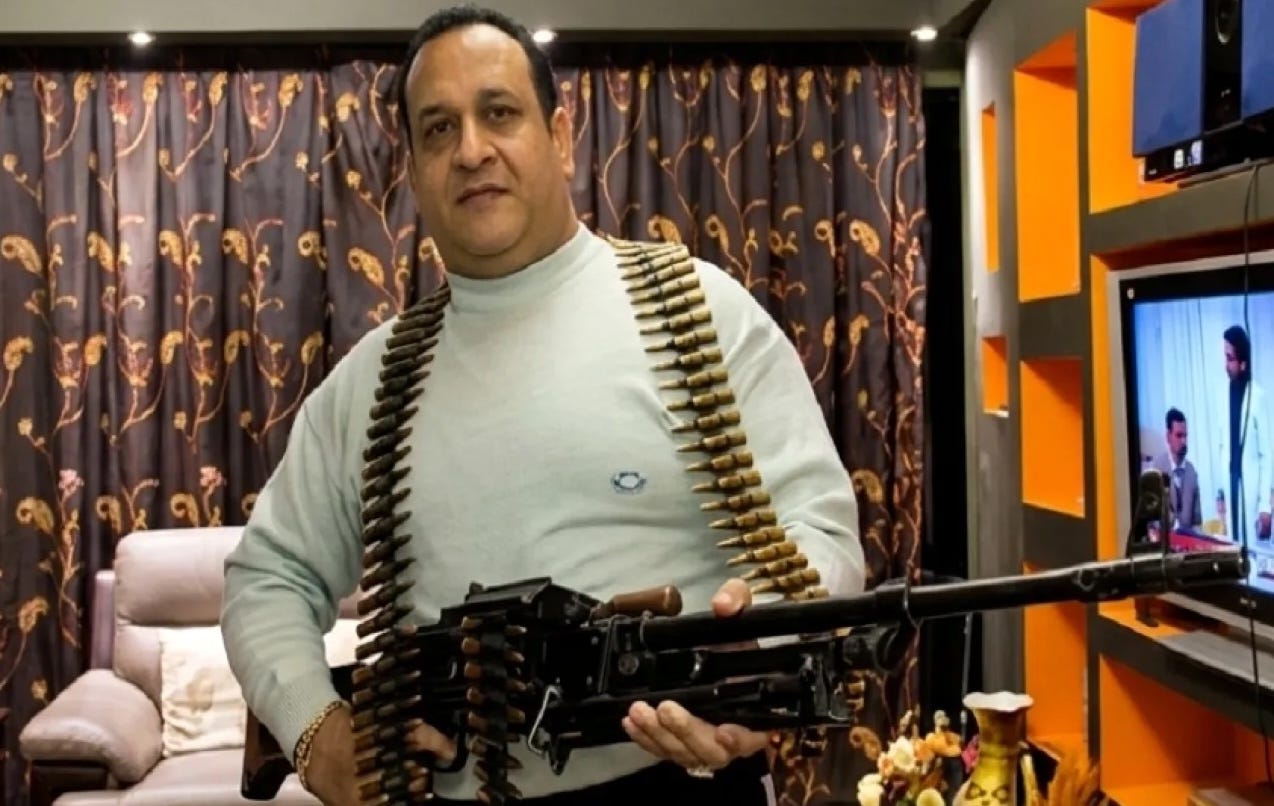
The Public Prosecution’s case is staggering, even by Egypt’s grim standards. Nakhnoukh, the notorious strongman long associated with baltagiya networks and security agencies, is accused of leading a gang that practiced thuggery, intimidation, unlawful detention, torture, coercion, and sexual assault, while using a security company as a front. Police reportedly found automatic rifles, a machine gun, a pistol, air rifles, air pistols, nearly a thousand rounds of ammunition, unlicensed communication devices, and antiquities. Prosecutors have frozen his assets, banned him from travel, and expanded the investigation after examining the defendants’ phones.
Nakhnoukh was not hiding in the shadows. He was hiding in plain sight. In 2014, he received a 28-year prison sentence on charges that included thuggery and illegal possession of weapons. Four years later, Abdel Fattah el-Sisi pardoned him. By 2023, Nakhnoukh had returned not as an embarrassed ex-convict, but as a businessman, acquiring control of Falcon Group, one of the country’s most prominent private security firms. He also maintained active profiles on Facebook and Instagram, and was an online sensation.
Falcon was no marginal outfit. Founded in 2006 with the Commercial International Bank as a major shareholder, the company grew into a sprawling security conglomerate serving embassies, banks, universities, government facilities, official events, ministers’ visits, and high-profile foreign guests. It employed former police and military officers. It also handled security for Sisi’s 2014 presidential campaign, before becoming part of the expanding architecture of post-coup repression, helping police university campuses as student activism was crushed through arrests, expulsions, military trials, and killings.
Falcon’s story is essentially about the outsourcing, privatization, and deniability of repression. Under Sisi, coercion no longer belonged only to uniformed police, army units, or intelligence agencies. It spread into companies, contractors, campus gates, event security, and civilian intermediaries whose power rested on proximity to the security apparatus.
The older roots of this world date to the Mubarak era. Nakhnoukh made his name under Mubarak as a man useful to the Interior Ministry and the ruling National Democratic Party, embedded in the economy of election thuggery, nightlife protection, debt collection, and violent brokerage. His own boast after 2011, that he was “president of the republic” of those working under him, was not just bravado. It captured the logic of Mubarak’s shadow governance, where police, ruling party brokers, businessmen, and criminals overlapped.
Under Sisi, however, the shadow moved into the open. Nakhnoukh’s post-pardon ascent into Falcon symbolized the New Republic’s confidence that yesterday’s baltagi could be repackaged as today’s security entrepreneur. Saheeh Masr reports that Falcon’s assets in 2023 stood at roughly LE779.9 million, with LE356.2 million in revenues and LE146.6 million in losses. The company was securing projects tied to the Engineering Authority of the Armed Forces, while Nakhnoukh’s network expanded through Upper Egypt by relying on local families, tribal relations, and armed groups.
That trajectory is the point. Nakhnoukh did not merely survive the transition from Mubarak to Sisi. He adapted to it. In Mubarak’s republic, men like him were deniable assets. In Sisi’s republic, they could become shareholders, chairmen, and partners in public order.
His arrest, then, should not be mistaken for the restoration of the rule of law. More likely, it marks a purge inside the ecosystem of coercion. Matsad2sh has reported one possible explanation: a struggle over Falcon itself. According to a senior legal source cited by the outlet, offers were made in 2025, then renewed in early 2026, for the Sovereign Fund of Egypt or other investors to acquire Falcon. Nakhnoukh reportedly refused over disagreements about the company’s valuation, while the proposed arrangements would have removed him from the chairmanship and replaced him with a retired military commander and a former police official.
The report should be treated cautiously, and I personally doubt it is true, though it fits the broader pattern. A Sovereign Fund of Egypt official immediately denied the allegations.
A more believable rumor circulating in political and journalistic circles, despite still-murky details, is that Nakhnoukh was targeted after a conflict with Ibrahim el-Organi, who clearly enjoys stronger state backing and greater political protection. Either way, the state is not disowning thuggery as a method. It may simply be seizing, disciplining, or reorganizing one node in its own security-business network.
Nakhnoukh’s fall is dramatic because it compresses the history of two regimes into one grotesque biography. The Egyptian state did not discover Nakhnoukh in 2026. It knew exactly who he was. It had used men like him for decades. The only novelty is that the monster is now on the wrong side of the cage.
Another Military Deployment, Another Official Silence
